
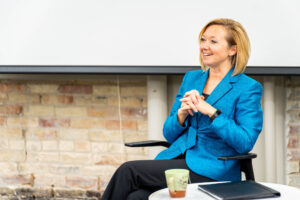
Neighbors had a great evening speaking with Mayor Rosalynn Bliss! Thanks to those who attended and shared your experiences with the Mayor.
Here are more details from our conversation:
River Restoration
Neighbors should soon start to see work begin on Grand River restoration projects in the urban core. Several projects are currently moving through the state environmental permitting process, including:
- The first phase of the Grand Rapids Whitewater project, which involves removing several small dams south of Michigan/Bridge Street, commonly referred to as the Lower Reach;
- The transformation of the river edge along the Grand Rapids Public Museum property;
- The rehabilitation of Lyon Square; and
- Extending the Downtown River Edge Trail north along the east bank from Leonard to Ann Street, which makes a key connection to Riverside Park and the Fred Meijer White Pine Trail State Park.
“The tipping point for being a recreation tourism destination is 100 miles of non-motorized trails.” -Mayor Bliss
Fingers crossed these projects move through the government permitting process this winter. With significant fundraising efforts already underway for each of these projects, long-discussed changes could start as early as next summer. The Lower Reach construction is expected to take at least 2 years.
Market Avenue Corridor Revitalization
Two properties along Market Ave south of Fulton St are currently the focus of redevelopment talks:
1. The corner of Fulton and Market: This privately-owned site is where Charley’s Crab was once located. The property owner is in the preliminary stages of exploring the feasibility of a mixed-use redevelopment project that could include much-needed housing, a hotel, new office space and street-level retail shops. The idea of a linear park along the river and a possible pedestrian bridge to GVSU are also being explored.
2. The City-owned property just south of US-131, known as “201 Market”: This is the property that the Convention and Arena Authority (CAA) would manage for the proposed outdoor Amphitheater. Grand Action 2.0 currently is working with the CAA to explore the feasibility of the amphitheater on the nearly 12-acre site.
The hope is that these projects could be designed and redeveloped together to add more density to the neighborhood and facilitate more growth for our Downtown along the currently underutilized waterfront.
The construction neighbors currently see underway along Market Ave is relocating a major “trunk sewer line” to help prepare the two properties for the potential redevelopment. Moving the sewer line under Market Ave also makes it easier to maintain in the future. The City expects to complete the project and reopen the streets by the end of this year.
Public Safety (Police)
The police have been extremely active in the Downtown neighborhood recently, making over a dozen arrests of drug dealers on our streets. Their enforcement capabilities will increase with more staff. The Police Department recently welcomed 11 new recruits and are using technical assistance funding approved by the City Commission on October 18 to engage in national recruiting efforts.
“We’ve heard the need for police presence loud and clear.” -Mayor Bliss
Our Police Department currently has one team for mental health co-response calls. This team is comprised of one police officer and one mental health professional that respond to 911, well-checks, and crisis calls across the City in order to address things that the police are often called for, but not trained to address. Such calls often include needs related to mental health and medical conditions.
The response has been extremely positive and the City looks forward to continued data collection on this effort. The Mayor mentioned the goal is to expand such teams in the future. Both the Police Department and Network 180 (the mental health professional provider) are short-staffed and need more resources and people to complete this important work.
Public Safety (Other Initiatives)
Several partners are coming together to pilot a Crisis Stabilization Unit in our city to divert people in need away from jail and the emergency room to address mental health and access 24-hour care. This project is just getting up and running but many participating agencies are looking forward to seeing the outcome of this work!
The Homeless Outreach Team has been a great addition to the City services in the neighborhood. A few major wins in this area:
- The City Commission recently approved the continuation of a locker program, giving an opportunity for individuals experiencing homelessness to safely store their items during the day. This gives dignity to people while keeping our streets clean.
- Hope Village was recently approved to create a tiny house community in which people can have a safe place to call their own to rapidly rehouse people as they exit homelessness.
Additional Questions from Neighbors
What can neighbors do about storefront vacancies?
The GRForward Plan and City retail attraction and retention efforts have focused on creating “retail corridors” in our city, rather than spreading it out around the large footprint of our Downtown. With the focus on Monroe Center and Division Avenue as “retail corridors” we’re making sure that shops group together. We’re also trying to get property owners to think differently about retail leasing by providing grants through the Downtown Development Authority so that our local small businesses can be successful while at the same time attracting national brands to our Downtown.
Which is better to provide to meet the needs of neighbors: providing housing or mental health services?
Both are necessary. Across Kent County, we take Housing First and Built for Zero approaches, which focus on providing a stable housing situation for individuals experiencing homelessness so that we can then focus on additional needed services. Because the services needed are so individualized, we need to provide the basic necessity of housing first. In the past, we’ve concentrated poverty in the Downtown area along Division and Ionia. We need to build more housing across all income levels across the City to strategically decentralize concentrations of poverty. Mixed-use buildings, mixed income levels, and mixed housing types across our city will help to address the need for housing and services instead of concentrating it into one area.